
THIS CONTENT REFLECTS THE PHILOSOPHY OF BOYLEDOWN LENDING INC., A CONSUMER FINANCE COMPANY LICENSED BY THE VIRGINIA STATE CORPORATION COMMISSION (LICENSE number CFI-256). IT IS INTENDED AS INFORMATIONAL CONTENT AND PROMOTES OUR LENDING MODEL. AS SUCH, IT IS CONSIDERED AN ADVERTISEMENT.
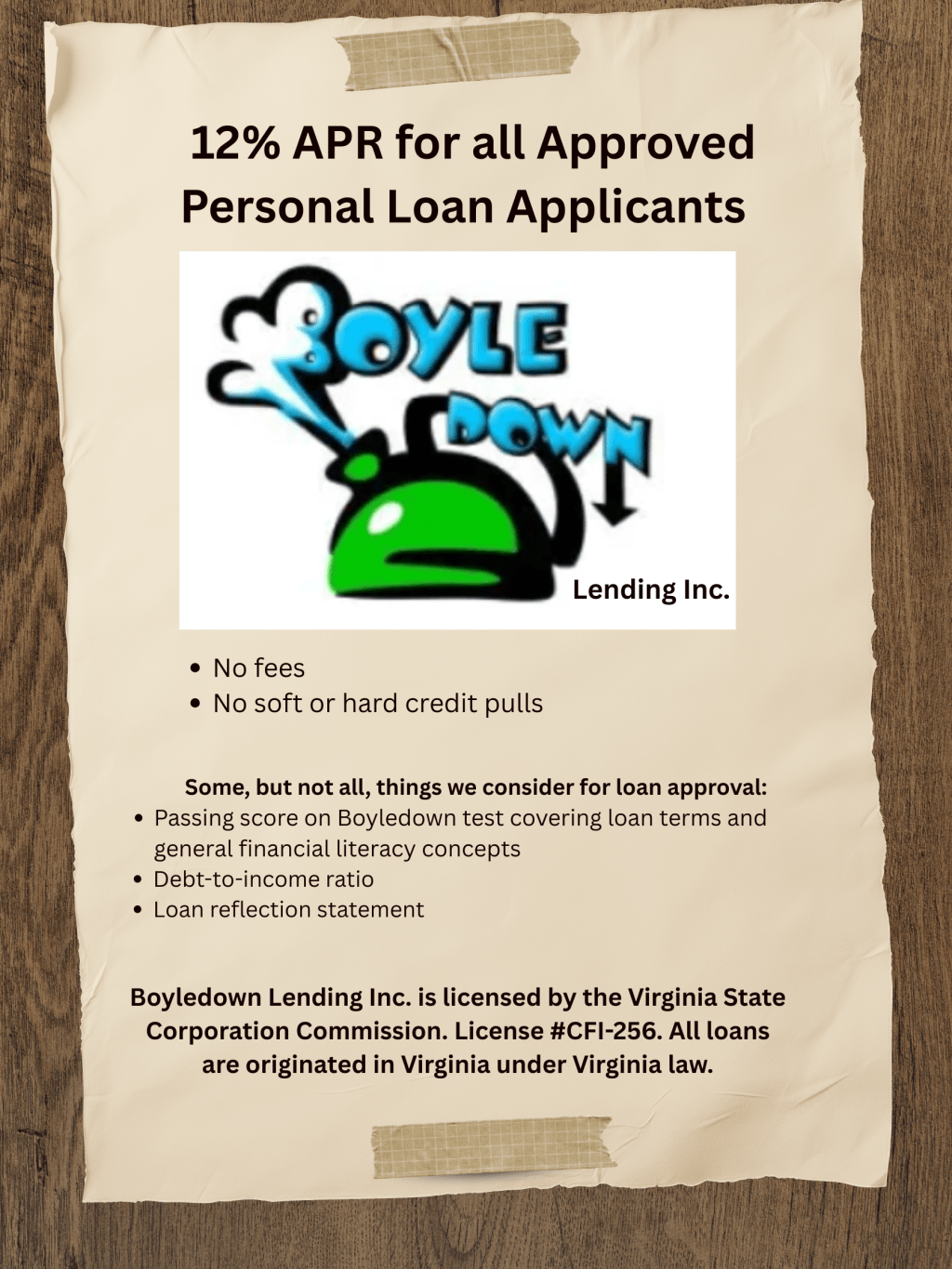
Consider our newest ad for a Boyledown personal loan:

AI Disclosure:
This article was developed with the assistance of artificial intelligence (AI) using OpenAI’s ChatGPT. While the ideas and editorial direction reflect the author’s perspective, portions of the research, structuring, and drafting were supported by AI-generated insights. All content was reviewed and finalized by the author.
Why the Ad Passes Basic Regulatory Muster
When writing advertisements or consumer-facing materials, lenders know the drill: stay within the boundaries of the statutes and regulations, and avoid the “big three” under UDAAP—unfair, deceptive, or abusive acts or practices.
When we first drafted the above ad, we made sure it passed the usual tests.
No Reg Z trigger terms that require additional disclosures.
Note that APR is an additional disclosure triggered by a triggering term. It is not a triggering term that requires additional disclosures in and of itself. There is NO statement of
(i) The amount or percentage of any downpayment.
(ii) The number of payments or period of repayment.
(iii) The amount of any payment.
(iv) The amount of any finance charge.
No fair lending issues.
There are no fair lending issues with Boyledown’s advertising restrictions. Geography is not a protected basis to deny loan applicants under the Equal Credit Opportunity Act (ECOA) or Regulation B, so limiting loans to Virginia residents does not, by itself, create a violation. Borrowers from other states could, in theory, travel to Virginia to apply for a loan in person, provided Boyledown is not actively soliciting or marketing loans to non-Virginia residents.
Caveat: This restriction is permissible so long as it is applied consistently and not in a manner that serves as a proxy for a protected class (e.g., race or national origin). Regulators could scrutinize the policy if geography-based rules result in disparate treatment or have a disparate impact on protected classes. For example, if a Maryland applicant is denied while a similarly situated North Carolina applicant is approved, and the denials disproportionately affect a protected class, that could create a disparate impact. Consistent application of the policy to all out-of-state applicants removes this risk.
State law disclosures are there.
Under 10VAC5-60-35. Advertising:
1. The name of the licensee as set forth in the license issued by the commission. Check.
2. A statement that the licensee is “licensed by the Virginia State Corporation Commission.” Check.
3. The license number assigned by the commission to the licensee (i.e., CFI-XXX). Check.
NO UDAP. BUT UDAAP?
Nothing unfair.
Nothing deceptive.
On that basis, it was regulatorily sound under consumer protection law.
But then we took a harder look at the abusiveness standard.
The “lack of understanding” element
The law defines an abusive act, in part, as one that takes unreasonable advantage of a consumer’s lack of understanding of the material risks, costs, or conditions of a financial product or service.
That last piece—conditions—caught our attention.
At Boyledown, we ask applicants for a few things that are unusual in the world of small personal loans:
- A passing score on the Boyledown Test
- A loan reflection statement
- A look at debt-to-income ratio
From a strict compliance standpoint, we could have left those details out of the ad. Regulators wouldn’t have found an issue with omission of that information. Assuming, for the sake of argument, that the omission was abusive, custom is still on our side if there is JUST abusiveness. This is because few, if any, abusiveness claims have ever been brought as single isolated causes of action. In other words, when an abusiveness claim is brought by a regulator, it is also brought alongside unfairness and/or deception.
Also, Virginia’s consumer finance “UDAP” statute, Chapter 15 § 6.2-1524 does not reference “abusive practices.” That said, understanding and mitigating potential abuses strengthens compliance, reduces regulatory risk, and reinforces ethical lending values. It also avoids CFPB enforcement, AG oversight (as they have the ability to enforce UDAAP), and best practices, make the abusiveness standard a practical and important guide for all lenders.
For all these reason, we added the conditional language to fully defend against the “lack of understanding” abusiveness prong.
Why? Because compliance isn’t just about law.
We believe transparency respects the time of our consumers. These applications aren’t five-minute quick clicks. They take thought and effort. By stating the conditions upfront, we make clear that this isn’t a “rubber-stamp” lending process.
It’s not just about meeting the letter of the law. It’s about meeting the spirit of compliance—and our own ethical standards. Enforcement philosophies and political agendas shift over time. The abusiveness standard is the quintessential example of that. Company ethics, however, do not necessarily have to.1
At Boyledown, our compliance culture is built on a simple principle: break our loan before you buy it. In the same way we want customers to break down and fully understand our loans, we break down our own advertisements. If it doesn’t hold up to scrutiny, we revise it.
The takeaway
We don’t just want to avoid being unfair, deceptive, or abusive. We want to show respect for our customers. Sharing conditions upfront ensures applicants understand the process and can make informed decisions (the purpose of TILA/Reg Z) before investing their time.
That’s the kind of compliance culture Boyledown is built on.
Disclaimer: This blog post is for informational purposes only and is not intended to provide legal, financial, or tax advice. You should consult your own attorney, financial advisor, or tax professional regarding your individual situation and any legal obligations applicable to your business or personal finances.
Email: doboyled@gmail.com
Phone: (631) 379‑0306
Mailing Address:
Boyledown Lending Inc.
285 Crockett Hill Lane
Cross Junction, VA 22625
- Of course, if the company ethics are no good, they should shift the same way political agendas should. ↩︎
 Boyledown Lending Inc.
Leave a comment